Sitting in a posh coffee shop in Bishkek's University neighborhood, my Kyrgyz friend and I were suddenly interrupted by a parade of shiny Mercedes-Benzes speeding through traffic, all mercilessly laying on their horns.
"Is that the President's motorcade?" I naively asked.
She flatly responded, "No, it's a wedding," as if I were born yesterday.
As I sat there looking confused, she went on to tell me that Kyrgyz weddings were raucous affairs involving plenty of alcohol and legendary late-night parties. It felt like a paradox—certainly not what I had in mind for a Central Asian nation that seemed so disconnected from Western boozebag culture.
"My brother's wedding was the same," she added, "although we rented an American stretch limo when we left the House of Happiness."
I almost spit out my coffee. "The House of Happiness? Are you joking?"
Only seconds later, I felt bad for letting my reaction get the best of me, but something about the phrase struck me as hilarious. In my mind, the name sounded like a cross between a horror movie and a Disney World attraction.
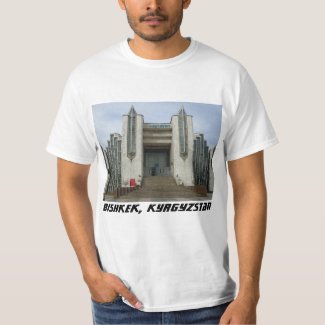
She proceeded to explain that the House of Happiness was a non-denominational, church-like structure used for civil ceremonies. As the Soviet Union worked to marginalize organized religion, the state built these improvised cathedrals to function as secular wedding halls.
"Take me there. I have to see the House of Happiness!" I blurted out.
To my delight, she responded, "It's only a 10-minute walk. We can go."
If you love to walk, Bishkek is a wonderful city to hit the pavement. It reminds me of New York because of its constantly bustling street scene. Even at 2 AM, people are hanging out, shooting the breeze, and patronizing the many newsstands selling cigarettes, soda, and snacks. While this walkability is partly a symptom of an economy where many people cannot afford cars, there is something comforting about being constantly surrounded by life. Just throw on a fur jacket, pull on some warm boots, and you’ll blend right in.
My excitement grew with every block. Finally, just past Bishkek's quirky Circus building, a concrete-and-glass behemoth emerged from the drab surroundings. It was everything I had expected and more. All I could do was stare in amazement, trying to make sense of it. The Crystal Cathedral came to mind, mixed with the Fashion Institute of Technology campus in New York. Put them together, and you get the House of Happiness. Unique? Ugly? Modernist? Who knew? Somehow, the strange fusion worked, and I loved it.
The building was clearly showing its age—several windows were shattered, and the stonework was crumbling—but I still felt a surge of euphoria as my friend and I walked arm-in-arm up the steps.
We opened the heavy doors to find an elderly Russian man sitting at a check-in desk, preparing the hall for ceremonies scheduled later that day. My friend asked if we could take some pictures.
"Only in the lobby," he answered in Russian.
The lobby featured a massive, vaulted ceiling framed by cold marble walls. Roped off in the center was a runner leading toward the primary ceremony hall.
"Please, ask if we can just step inside the main hall," I begged my friend.
She relayed the request, but the old man held firm. "Only the beautiful lady in white is allowed to walk on that carpet."
Feeling slightly shafted, we could only peer in from the threshold. A vast, round stained-glass window immediately caught my eye, filtering the sunlight into warm rays that made the grand arched structure feel surprisingly comforting. Even though the venue was never a place of worship, it possessed a distinct, almost spiritual presence. Despite the wear and tear, I was thrilled to see it still active and serving its original purpose.
As we stepped back outside, my friend asked a few locals to snap a photo of us on the grand staircase. They happily obliged, likely assuming we were contemplating our own wedding at the House of Happiness.
Back at the hotel, I immediately jumped online to research the background of this extraordinary building. It turned out my friend’s translation was slightly informal; the structure is officially known as a Soviet "Wedding Palace." The USSR began constructing these across its territories in the late 1950s, commissioning bold, modernist designs for each republic. I discovered that an oligarch had even bought the former Wedding Palace in Tbilisi, Georgia, to use as his personal mansion!
While many of these Soviet-era monuments have fallen into disrepair or face stiff competition from traditional religious institutions, Bishkek’s Wedding Palace remains open to the public—a vibrant, lingering relic of a bygone era that I hope stays preserved for generations to come.